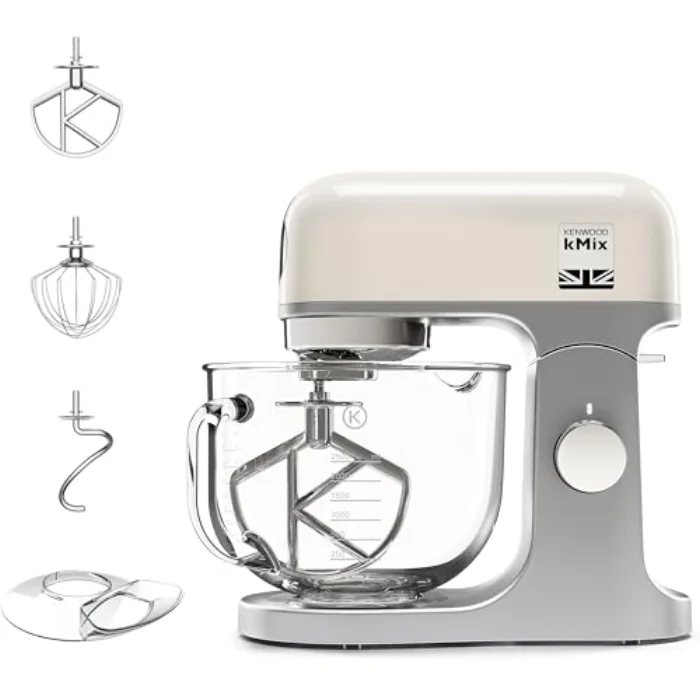
Kenwood has been a fixture in British kitchens for generations, and the kMix is the model that brings the brand's substance down to a sensible price. It is the machine we recommend most often, because it gives most home bakers everything they actually need without paying for an ecosystem they may never use. That makes it our best value pick, and a serious rival to mixers costing twice as much.
Who is the Kenwood kMix for?
The kMix is the right mixer if you bake regularly and want die-cast build quality and real power without spending premium money. The 5 L bowl is slightly larger than the KitchenAid Artisan's, so it copes well with a generous cake batch or a loaf, and the 1000 W motor gives it the muscle to knead regular bread dough as well as whip cream and meringue. It suits the practical baker who cares more about how the machine performs than about its badge or its colour range, and who wants a unit backed by UK service and spares.
It is less ideal for anyone who wants the widest possible attachment ecosystem, where KitchenAid pulls ahead, or for someone who bakes only a few times a year and would be better served by a budget machine like the Aldi Ambiano. For the great majority of home bakers, though, the kMix sits right in the sweet spot of price and ability.
How the Kenwood kMix performs
Mixing power
The 1000 W motor is the headline, and in use it earns it. The kMix whips cream and egg whites quickly and to a good volume, creams butter and sugar smoothly, and, crucially, has the torque to knead a normal bread dough without bogging down. Its planetary K-beater reaches the bowl well, and the six speeds plus pulse give enough control for both gentle folding and fast aeration. For everyday baking it does not feel short of power, which is the whole point at this price.
Build and stability
The kMix's die-cast metal body is the feature that separates it from cheaper machines. It gives the mixer real weight, so it stays put on the worktop better than a plastic-bodied budget unit, and it feels reassuringly solid. On the stiffest doughs it shows a touch more counter wobble than the heavier KitchenAid, but for normal home baking it is stable and confident. The controls are functional rather than luxurious, which is a fair trade at this price.
Attachments and support
The kMix comes with the K-beater, dough hook and whisk that cover almost all home baking, and Kenwood offers optional attachments through its accessory outlet, though the range is narrower than KitchenAid's. Just as valuable is the after-sales side: Kenwood is an established UK brand with accessible service and spare parts, which matters for a machine you hope to keep for years. If you want to understand which tool does what, see our buying guide.
The honest trade-offs
The kMix's compromises are modest and predictable. You do not get the deep attachment ecosystem or the very last word in refinement that the premium machines offer, and the controls and styling are practical rather than special. On a daily heavy-bread routine a dedicated bowl-style machine like the Bosch MUM5 would be even more comfortable. But none of these are flaws so much as the natural cost of a much lower price, and for the money the kMix gives up remarkably little.