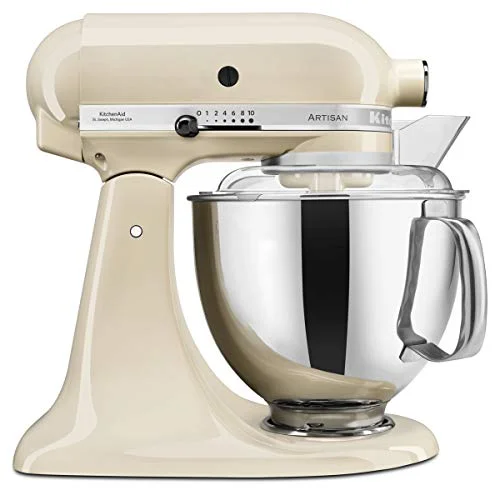
Who is the KitchenAid Artisan for?
The Artisan is the right machine if you bake regularly, want results that are consistent year after year, and would rather buy once than replace a cheaper mixer twice. With a 4.8 L stainless steel bowl it comfortably handles a standard family cake, a batch of biscuits or a single loaf, and the tilt-head design makes loading and cleaning genuinely easy. It suits the baker who treats the mixer as a long-term tool rather than an occasional helper, and who values build quality and an expandable feature set over the lowest possible price.
It is less suited to anyone who bakes only a couple of times a year, where the cost and the weight are hard to justify, or to bakers who routinely make very large batches and would be better served by KitchenAid's bigger bowl-lift models or a deep bowl-style machine. For everyday family baking, though, the Artisan has power and capacity to spare, and the smaller, lighter options here cannot match its longevity.
How the KitchenAid Artisan performs
Mixing power and action
The Artisan's planetary action, where the beater spins one way while travelling around the bowl the other, reaches every part of the mix, so you rarely have to stop and scrape down. It creams butter and sugar to a pale, light fluff, folds delicately at low speed, and whips cream and egg whites to a stable volume. On bread dough it is confident: the 300 W direct-drive motor is geared for torque rather than raw watts, and the machine's weight keeps it planted while the dough hook does its work. It is not a high-volume bread machine, but within its bowl capacity it kneads well.
Build quality
This is where the brand premium shows most clearly. The body is dense cast metal, not plastic, so it stays still even on a stiff dough where lighter mixers walk across the counter. The finish is excellent, the controls are simple and tactile, and these machines are known to last for many years and often a decade or more. It is heavy to lift in and out of a cupboard, which is the flip side of that solidity, so many owners simply leave it out, helped by the range of colours.
The attachment ecosystem
The universal power hub on the front is the Artisan's quiet superpower. It accepts more than fifty optional attachments, turning the mixer into a pasta roller, meat mincer, spiraliser, grain mill or vegetable slicer. No other brand here matches that range. If you are likely to take baking and food prep seriously over the years, that expandability is a real, lasting advantage, and a big reason these machines hold their resale value. We cover the practical jobs in our guide to what you can make with a stand mixer.
The honest downside: price and weight
The Artisan's only real drawbacks are that it is the most expensive machine here and that it is heavy to move. Neither is a fault: you are paying for cast-metal construction, a refined action and the attachment ecosystem, and the weight is what keeps it stable. If you bake only occasionally, a die-cast mid-range machine such as the Kenwood kMix will do the same everyday jobs for far less, and the budget Aldi Ambiano covers light baking for a fraction of the price. If you want a mixer for life and the option to expand it, the premium is money well spent.